Transformations of Antisemitic Discourse in Poland – from the Gross Controversy to the Gaza Debate
On February 24, 2026, the research seminar Transformations of Anti-Semitic Discourse in Poland – From the Gross Controversy to the Gaza Debate will be held by Dr. Magdalena Nowicka-Franczak.
Antisemitic discourse has been a persistent element of public debate in Poland, yet it has undergone certain transformations which reflect the changing dynamics of the discussion. As the debate itself shifts in direction, focus, and the repertoire of social actors admitted to its mainstream, so too does the antisemitic discourse that forms part of it. Its visibility is conditioned by interdependent periods of intensification and suppression, while its types serve as a particular response to symbolic struggles among different elite groups.
Dr. Magdalena Nowicka-Franczak’s presentation constituted an attempt at a critical description of the place occupied by antisemitic discourse in public debate in Poland over the past quarter-century. Beginning with the controversy surrounding the book Neighbors by Jan Tomasz Gross and the subsequent related discussions on Polish complicity in the Holocaust, moving through the political and religious instrumentalization of antisemitic prejudices, and reaching the new-media normalization of pseudo-folkloric forms of stigmatization of Jews, Dr. Nowicka-Franczak situated the problem of antisemitism within one of the central dimensions of public debate after 1989—dynamic continuity. She referred to the simultaneous persistence and plasticity (sometimes subversiveness) of topoi, narrative-argumentative structures, and rhetorics based on group stereotypes. Antisemitic discourse can be produced according to two models of public debate, which she calls “grand synthesis” and “small analysis.” While the former consists in combining fragments of discourse from different domains, and the latter in separating conflicting interpretations from one another regardless of their deeper causes, both entail rejecting a critical perspective.
The current context is the war in the Gaza Strip. These events have fueled the production of antisemitic discourse that merges criticism of Israel with phantasmal narratives undermining knowledge on the Holocaust and its consequences. This phenomenon affects both the social understanding of antisemitism and the public ways of discussing the Polish–Jewish past.
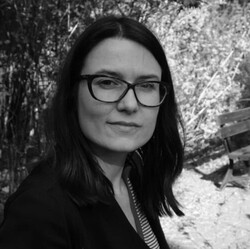 Magdalena Nowicka-Franczak – sociologist, researcher of public discourse, and literary critic. She works at the Institute of Sociology, University of Lodz. Her research focuses on collective memory, symbolic power, and the discourse of symbolic elites. She is the author of Niechciana debata. Spór o książki Jana Tomasza Grossa [The Unwanted Debate: The Controversy over the Works of Jan T. Gross] (2017). Within the Polish Sociological Association, she chairs the Section for Social Communication Research. She is a member of the editorial boards of Tygiel Kultury and Studia Socjologiczne, and sits on the juries of the Julian Tuwim Literary Award and the Irena Tuwim Translation Award. She writes about literature for Tygodnik Powszechny, Dwutygodnik, and Pismo. Magazyn Opinii.