The Encyclopedia of the Warsaw Ghetto and Its International Dimension under the EHRI-PL Project
Thanks to the involvement of European Holocaust Research Infrastructure Poland, the “Encyclopedia of the Warsaw Ghetto” is undergoing a process of internationalization through the translation of entries into English, its resources are being integrated into the global scholarly discourse and the accessibility of Polish Holocaust research for the international academic community is significantly enhanced.
The Jewish Historical Institute carried out the “Encyclopedia of the Warsaw Ghetto” research project in the years 2018–2024 as part of the National Humanities Development Program. The project produced a unique compendium of knowledge on the Warsaw ghetto, the largest ghetto set up by the Germans in occupied Europe. In its digital version, the Encyclopedia comprises over 2,000 entries on individuals, institutions, events, and various aspects of life in the Warsaw ghetto, painting a multidimensional picture of its history, space, and residents.
The Encyclopedia is not only a crowning achievement following many years of research, including works on the Ringelblum Archive, but also a modern tool useful for scholars studying the Holocaust and related topics. Its digital version makes it possible to link entries to source materials, update content following new discoveries, and use tags for easier search and browsing.
The Encyclopedia’s reviewers have emphasised its significance. Samuel Kassow, an accomplished researcher of the Warsaw ghetto and the Ringelblum Archive, pointed out in a review written for the Zagłada Żydów. Studia i materiały journal that the publication “creates an intricate network of knowledge on various aspects of life in the Warsaw ghetto” by aggregating scattered academic data and thus making this knowledge more accessible to both experts and lay audiences.
An important factor in bringing the Encyclopedia to the international scene is the involvement of the European Holocaust Research Infrastructure Poland (EHRI-PL). One of the project’s tasks is to translate the entries into English, making the body of knowledge produced by Polish scholars available to international academic circles and to broad audiences interested in the history of the Holocaust. Thanks to the partnership with EHRI, the Encyclopedia of the Warsaw Ghetto has a chance to transcend its local context and become accessible to scholars all over the world, many of whom have been inquiring about an English version since the completion of the project.
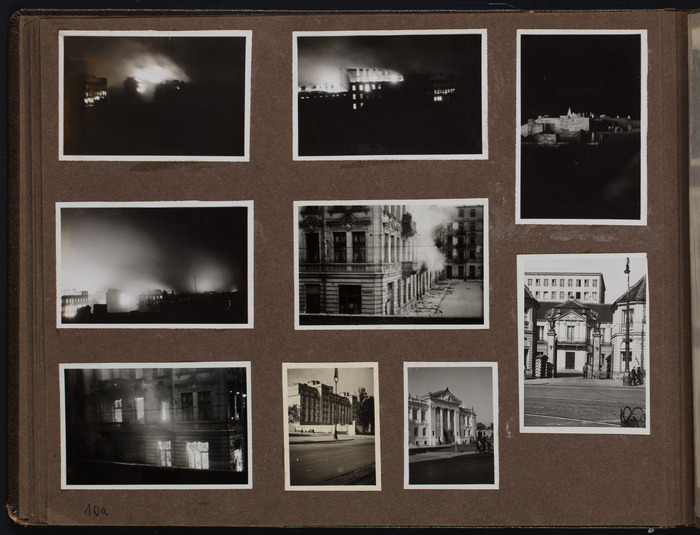
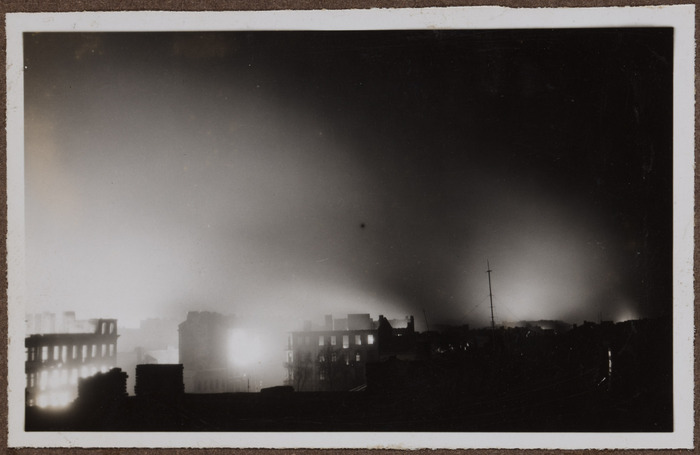
Source: DZIH E-19/9v/4, A card from the private album of Lieutenant Colonel Franciszek Przymusiński (commander of the Polish Police in Warsaw): fires in the ghetto during the uprising, April–May 1943, collection of the Jewish Historical Institute