
Hasag in Skarżysko-Kamienna from the Perspective of EHRI Research: A Study of a Forced Labour Camp in the General Government
The approach to Holocaust research developed by the European Holocaust Research Infrastructure emphasises the need to integrate dispersed sources and to build a transnational infrastructure for access to testimonies. In this context, the accounts of former prisoners of the Hasag forced labour camp in Skarżysko-Kamienna, preserved in the archives of the Jewish Historical Institute, constitute an important component of the European documentary record. The article by Marta Janczewska of the Research Department of the Jewish Historical Institute analyses the specific character of this camp in comparison with other forced labour centres in the General Government.
Fonds no. 301 at the Jewish Historical Institute comprises over 7,000 testimonies, of which about 200 come from former prisoners of the labour camp which operated at the munitions factory in Skarżysko-Kamienna, run by the Hasag company.
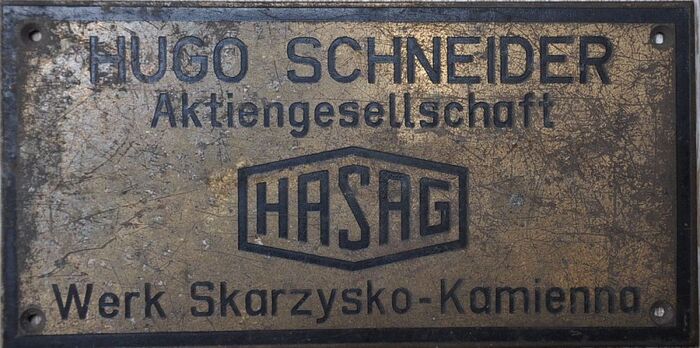
Opened in early summer 1942, the “factory camp” operated on the premises of the production plant in Skarżysko and was the first camp of its kind in the General Government. Its unique nature derived from the status of the Jewish prisoners, who became the “property” of a private company – the Hasag corporation (Hugo Schneider Aktiengesellschaft Metallwarenfabrik; Hugo Schneider’s Metal Good Factory PLC) – and the guards were not SS officers, but Volksdeutsche and Ukrainians recruited by the camp management. Many other companies followed in Hasag’s footsteps and opened camps at their production plants.
At the turn of 1942/1943 and over the entire year, the Nazis established numerous labour camps at munitions factories or heavy industry plants. They were also actively expanding the existing camps. The companies which oversaw their operations became the biggest beneficiaries of Jewish slave labour during Operation Reinhard. Facing a shortage of Polish wage workers, who were being sent en masse to the Third Reich, the Germans decided to use Jewish labour, up to that point not exploited in munitions production. Apart from Hasag, which had plants in Skarżysko-Kamienna, Kielce, and Częstochowa, other companies which held Jewish workers in “factory camps” were Hermann-Göring-Werke (eight camps in Starachowice, Ostrowiec Świętokrzyski, and Stalowa Wola – freight wagon production, crude iron and steel smelting, rolled metal products for projectiles, cannon, bomb, and submarine parts), Steyer-Daimler-Puch A.G. in Radom (pistol, rifle, and bicycle production), or Heinkel Flugzeugwerke in Mielec and Budzyń (airplane parts).
Hasag ran the largest camp from among those mentioned above, exploiting thousands of Jewish labourers in inhumane conditions. Work at the factory was extremely dangerous, and Jews were assigned the most gruelling, high-risk tasks. A single shift (day and night) lasted 12–14 hours, and the workers received beatings from Ukrainian and German guards and from Polish foremen. Laborers working at Werk C, where projectiles were filled with TNT and picric acid, were subjected to the most horrific conditions. Picric acid fumes discoloured the workers’ skin and hair, giving them a distinct yellow hue. They also burnt through clothes. The view inside the factory halls resembled a crowd of yellow spectres wearing paper bags. Toxic dust damaged their eyesight and lungs. In addition, the prisoners were chronically underfed, with the daily ration consisting of 200 g of bread and two portions of watery soup. The management did not adhere to rudimentary hygiene rules, so the workers were decimated by typhus and dysentery. The factory was marred by accidents: rush and careless handling of explosives without proper protection triggered explosions which resulted in prisoners dying or suffering permanent injuries.
According to the testimony of Felicja Karay, up to 25,000 Jews passed through the Hasag factory camps. The number of deceased forced labourers may have reached 18,000.
Basic reference list: Testimonies from Fonds no. 301, JHI Archive.
Felicja Karay, Death Comes in Yellow. Skarżysko-Kamienna Slave Labor Camp, transl. S. Kitai, Amsterdam 1996.
Krzysztof Gibaszewski, Hasag. Historia obozu pracy przymusowej w Skarżysku-Kamiennej, Skarżysko-Kamienna 2015.
Jacek Wijaczka, Grzegorz Miernik, “Żydowscy robotnicy przymusowi w zakładach zbrojeniowych Hasag w Generalnym Gubernatorstwie w czasie II wojny światowej,” in: Z przeszłości Żydów polskich. Polityka – gospodarka –kultura – społeczeństwo, eds. J. Wijaczka, G. Miernik, Kraków 2005.
Alicja Bartnicka, One step to freedom? The plight of Jewish forced laborers in the Hasag ammunition factory in Skarżysko-Kamienna after the plant evacuation, “Holocaust Studies” 2024, vol. 30, no. 3.
Józef Marszałek, Obozy pracy w Generalnym Gubernatorstwie w latach 1939–1945, Lublin 1998.
Source: https://muzeum.skarzysko.pl/aktualnosci/item/460-rocznica-likwidacji-obozu-pracy-hasag.html